Yes. You may be able to file an injury claim after a multi-car accident on I-85 in Greenville when another driver, a commercial vehicle operator, an employer, a maintenance company, a manufacturer, or another responsible party contributed to the crash.
These claims often involve several impacts, conflicting accounts, multiple insurance policies, and efforts to shift blame. The main questions are how the chain reaction began, whether later drivers increased the harm, which insurance policies apply, and how the collision affected your health, work, transportation, and daily life.
Christian & Christian Law helps injured people in Greenville, South Carolina, and nearby areas understand the fault, evidence, insurance, and filing issues that may affect an I-85 multi-car accident claim.
More than one driver and more than one insurance policy may affect a pileup claim. Each impact should be investigated separately.








Can You File a Claim After an I-85 Pileup? 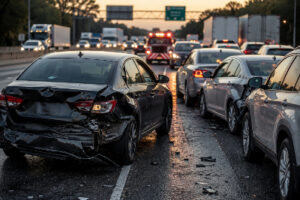
A multi-car accident claim is not limited to the driver who caused the first impact. Liability depends on the full sequence of events.
One motorist may start the collision by following too closely. Another driver may increase the harm by speeding, looking at a phone, changing lanes without enough space, or failing to react to stopped traffic. A commercial vehicle may cause a later impact that produces separate injuries or makes existing injuries worse.
You may have a claim when evidence shows that another person or business failed to use reasonable care and caused or contributed to your injuries. Depending on the facts, the claim may involve one responsible party or several parties.
Learn more about how liability may be evaluated in a multi-vehicle crash:
https://www.cclawfirm.com/how-is-liability-determined-for-a-multi-vehicle-car-accident/
Founded in 1975, Christian & Christian has deep roots in the community. 
Only Serving People, Never Companies


How Multi-Car Crashes Develop on I-85
Traffic on I-85 near Greenville can compress quickly around merges, exits, work zones, disabled vehicles, and earlier collisions. Vehicles may be traveling at highway speed before traffic slows within seconds. A distracted driver or a motorist following too closely may strike slowing traffic and push one vehicle into another.
A chain-reaction collision may also begin with a sideswipe, lane departure, tire failure, loose cargo, or commercial truck that cannot stop in time. Several drivers may make separate mistakes during the same event.
Common contributing acts include:
- Following too closely
- Driving too fast for traffic or road conditions
- Distracted driving
- Unsafe lane changes
- Failure to maintain a lane
- Fatigued driving
- Impaired driving
- Defective brakes, tires, lights, or steering components
- Improperly secured cargo
- Failure to respond reasonably to stopped or slowing traffic
The first collision is not always the only cause of an injury. A person may be struck twice, pushed into another lane, or hit by a driver trying to avoid the original crash.
Who May Be Responsible for a Multi-Car Accident?
The responsible parties depend on what caused each impact. Potentially responsible parties may include:
- A passenger vehicle driver
- A commercial truck or delivery driver
- A motor carrier
- An employer
- A vehicle owner when the facts support a recognized legal basis for liability
- A maintenance or repair provider
- A vehicle or parts manufacturer
- A cargo-loading company
- A government entity in limited circumstances
Vehicle ownership alone does not establish fault. An owner may become relevant when the owner’s conduct, permission, or relationship to the driver creates a legal basis for responsibility.
An employer may be responsible when a driver caused the crash while acting within the scope of employment. A maintenance provider or manufacturer may be involved when defective brakes, tires, steering, or another component contributed to a loss of control.
Commercial vehicle claims may require driver logs, maintenance records, inspection reports, dispatch messages, electronic vehicle data, and company policies. Early preservation can help prevent useful evidence from being lost or overwritten.
Claims involving a government entity may have different procedures, shorter deadlines, and legal limitations. These claims require prompt review.
Everyone there was very professional, knowledgeable, and friendly. My car was totaled, and I was a little intimidated talking with a couple of other lawyers in Greenville. But with Christian and Christian, not only did they answer my questions, but they did so in a way that made what could have been a hectic situation, easy. Overall, an excellent experience with high quality lawyers who truly go above and beyond and really try to get you the results or answers you need. I met Josh like 4 years ago when my Son was injured at Daycare. He was very concerned about the well being of my Child and Me. Very Understanding Professional and Just a great Staff. If You need a Lawyer that’s all about YOU this is the Place. I just closed a Case on 6/23/2021 from a injury on a Property. They handled everything because no one else would help Me. I’m forever grateful for Your hard Work and Time. Once again Thank You Josh and Sally. My husband was referred to this law firm from another lawyer after his mother passed away while residing in a nursing home. Matt took on his case and we are pleased with how everything turned out. It took a long, long time to finally settle, but it was worth the wait. The staff here is friendly and I’d be happy to recommend them to anyone needing legal assistance. I was referred to Harold by a family friend, and I couldn’t be happier. He took the time to listen to my case, answered all my questions and truly treated me like a friend not a client. His knowledge of medical malpractice is priceless he actually successfully won, one of the first medical malpractice cases in Greenville County.
—Rob Young
—Rezillai Henderson
— Jen
— Lindsey
What Evidence Can Show How the Crash Happened?
A police report can provide useful information, but it may not capture every impact or resolve every disagreement. Officers often arrive after vehicles have moved, and drivers may remember the sequence differently.
Useful evidence may include:
- Photographs of every vehicle and each damage point
- Photographs of debris, lane markings, skid marks, and road conditions
- Dash camera, traffic camera, or nearby surveillance footage
- Witness names, statements, and contact information
- 911 calls and emergency response records
- Vehicle event data and electronic control module information
- Cell phone records when distraction is supported by the facts
- Inspection records for brakes, tires, lights, and steering systems
- Commercial driving, maintenance, cargo, and dispatch records
- Medical records connecting injuries to the collision
- Repair estimates, wage records, receipts, and other proof of loss
Vehicle damage patterns can help show which impact came first. A vehicle with rear and front damage may have been pushed forward instead of independently striking the vehicle ahead.
In a serious or disputed claim, an accident reconstruction professional may compare vehicle damage, roadway evidence, electronic data, photographs, and witness accounts to evaluate the sequence of impacts.
Value of a Personal Injury Case
Choosing a Personal Injury Attorney
Related Videos
What Should You Do After a Multi-Car Accident?
Your safety and medical needs come first. Call 911, follow emergency instructions, and move away from active traffic lanes when you can do so safely. Do not stand between damaged vehicles or near moving interstate traffic.
When your condition permits:
- Seek medical evaluation and follow treatment instructions.
- Photograph the scene, vehicles, visible injuries, and surrounding conditions.
- Exchange driver, employer, and insurance information.
- Collect witness names and contact information.
- Preserve dash camera footage before it is overwritten.
- Keep towing, rental, medical, pharmacy, and travel receipts.
- Avoid guessing about speed, distance, or fault.
- Do not sign a release before you understand your injuries and losses.
- Record symptoms, missed work, and limits on daily activities.
- Seek legal guidance before vehicles are repaired or electronic evidence disappears.
Before giving a detailed recorded statement to another driver’s insurance company, review the firm’s guidance:
https://www.cclawfirm.com/how-to-speak-to-an-insurance-adjuster-after-an-accident/
Your own insurance policy may require cooperation. Read your policy and seek legal advice before refusing a request from your insurer.
Why Do Multiple Insurance Companies Complicate a Claim?
Each driver may have a separate insurer, and each company may try to reduce its policyholder’s share of fault. One insurer may argue that the first driver caused the entire crash. Another may claim that a later impact caused your injury. A third may dispute whether your medical condition resulted from the collision.
Your own uninsured or underinsured motorist coverage may also matter when a responsible driver has no usable coverage or lacks enough coverage to address the documented harm. Coverage can depend on policy language, the vehicles involved, household policies, employment relationships, and other facts.
Do not assume that the first settlement offer accounts for every responsible party or available source of coverage. A release signed with one insurer can affect other claims. Review the proposed release and the full insurance picture before signing.
Verdicts & Settlements
How Do South Carolina Shared-Fault Rules Apply?
South Carolina follows modified comparative negligence. In many negligence cases, you may recover damages when your share of fault is 50 percent or less. Your recovery is reduced by your assigned percentage of fault. You are generally barred from recovering when your fault exceeds 50 percent.
For example, if your proven damages are $100,000 and you are found 20 percent at fault, the recoverable amount may be reduced by $20,000 before other legal and insurance issues are considered.
An insurer may argue that you were following too closely, driving too fast, changing lanes, or failing to avoid the collision. Photographs, video, witness accounts, vehicle data, and expert analysis can help answer those allegations.
Multi-party cases may require fault to be allocated among several drivers. The evidence should address each driver’s conduct and each impact rather than treating the crash as one simple event.
Read more about partial fault in a South Carolina car accident:
https://www.cclawfirm.com/what-happens-if-youre-partially-at-fault-in-a-south-carolina-car-accident/
What Compensation May Be Available?
The value of an I-85 multi-car accident claim depends on fault, injury severity, medical evidence, available insurance, and the long-term effect of the collision.
Recoverable losses may include:
- Emergency treatment and hospital care
- Surgery, rehabilitation, and follow-up appointments
- Future medical care supported by evidence
- Lost wages
- Reduced earning capacity
- Vehicle repair or replacement
- Rental and transportation expenses
- Pain, physical limitations, and loss of normal activities
- Wrongful death damages when a collision is fatal
No lawyer can promise a result or a specific claim value. A careful evaluation considers current losses, future consequences, available insurance, and the strength of the supporting evidence.
How Long Do You Have to File an Injury Claim?
South Carolina Code Section 15-3-530 generally provides a three-year filing period for many personal injury actions. Section 15-3-535 states that many injury actions must be filed within three years after the person knew, or through reasonable diligence should have known, that a cause of action existed.
A different deadline may apply when the claim involves a government entity, death, a minor, or another special circumstance. Under the South Carolina Tort Claims Act, an action is generally barred unless it is commenced within two years after the loss was or should have been discovered. A three-year period may apply when a qualifying administrative claim was first filed under the Act.
Do not treat three years as a reason to delay. Video may be overwritten, vehicles may be repaired, commercial data may be deleted, and witnesses may become harder to locate.
The firm’s personal injury case timeline explains how investigation, medical treatment, negotiation, and litigation may develop:
https://www.cclawfirm.com/personal-injury-case-timeline/
How Can a Greenville Car Accident Lawyer Help?
A lawyer can investigate the sequence of impacts, identify responsible parties, preserve evidence, review insurance policies, document damages, and respond to blame-shifting arguments. Counsel can prepare the case for negotiation or trial without assuming that a quick settlement is the right outcome.
Consider a hypothetical example. Traffic slows on I-85 near Greenville. A pickup stops safely, but a distracted sedan strikes it. Seconds later, a delivery van traveling too fast hits both vehicles. The sedan driver may have caused the first collision, while the van driver may be responsible for a second impact and added injuries. The delivery driver’s employer and commercial insurance may also require review.
The claim should reflect the full sequence of events instead of treating the crash as one simple rear-end collision.
Learn more about the firm’s approach to Greenville car accident claims:
https://www.cclawfirm.com/greenville-car-accident-lawyers/
Speak With a Greenville Car Accident Lawyer
If you were injured in a multi-car accident on I-85 in Greenville, Christian & Christian Law can review the collision, explain the insurance and fault issues that may apply, and help identify evidence that should be preserved.
The firm has served injured people in Greenville and nearby Upstate communities for decades. Christian & Christian Law only serves people, never companies.
Call for a free legal consultation:
(864) 408-8883
tel:+18644088883
Contact the firm online:
https://www.cclawfirm.com/contact-us/
This article is for informational purposes only. It is not legal advice and does not create an attorney-client relationship. Consult an attorney about the facts and deadlines that apply to your situation.

|
The National Trial Lawyers: Top 100
Medical Malpractice: Top 25 Trial Lawyers Association
The National Trial Lawyers: Trucking Trial Lawyers |
The National Trial Lawyers: Top 25 Workers' Compensation Trial Lawyers
The National Trial Lawyers: Top 25 Products Liability Trial Lawyers
Expertise.com: Best Personal Injury Lawyers in Greenville |